
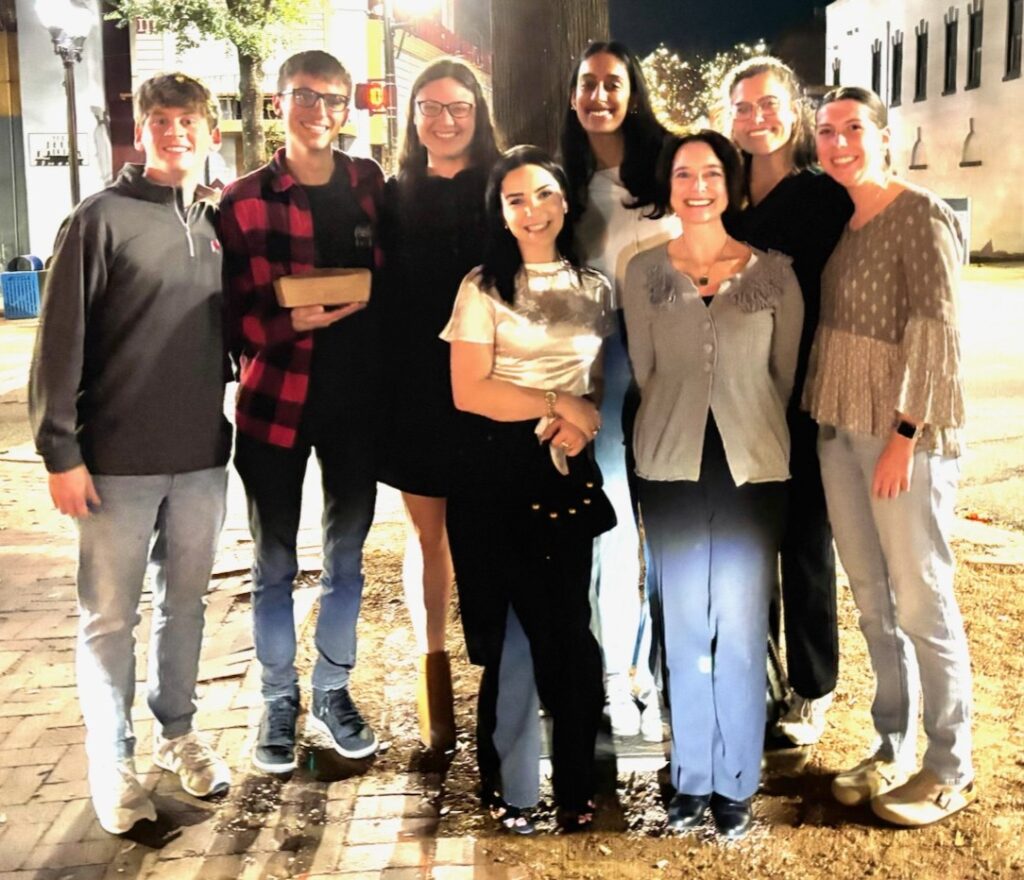
Left to right: Eric Pruitt, Ben Privitera, Christina Lee, Carly Judenberg, Divya Kishore, Clare Norins, Julia Terry, and Jordan Elwarner
The UGA First Amendment Clinic added four new litigation cases to its free expression docket.

Hollingsworth v. Williams
A county sheriff and his investigator obtained an arrest warrant accusing the the Clinic’s client of “harassing communications” based on her political speech. She could not return home from her out-of-state job for fear of being arrested. The warrant was eventually recalled by the magistrate court. The lawsuit asserts that this series of events violated the First Amendment.
Clinic students Jordan Elwarner, Eric Pruitt, legal fellow Christina Lee, and attorney Ward Evans prepared and filed the case under the supervision of Clinic director Clare R. Norins.
Discovery in the case is ongoing with the help of Spring 2026 Clinic students Kellianne Elliott, Nicholas Ames, and Jordan Elwarner.
Case No.: 1:25-cv-00238 (S.D. Ga.)

Roberson v. Bacon County School District
On behalf of an engaged citizen in Bacon County, the Clinic filed a complaint and moved to stop enforcement of the school district’s public comment policies that were out of step with constitutional requirements for regulating speech in a limited public forum. A court-ordered settlement conference was held in December.
Clinic students Jacob Levy, Ben Privitera, and legal fellow Christina Lee prepared and filed the complaint and preliminary injunction motion under the supervision of Clinic director Clare R. Norins and co-counsel Gerry Weber.
Read how this case removed barriers to public comment in Bacon County.
Case No.: 5:25-cv-00125 (S.D. Ga.)
Guevara v. Francis, 2:25-cv-00104 (S.D. Ga.)
The Clinic represented Georgia-based journalist Mario Guevara in filing a habeas petition and motion for his emergency release from detention by U.S. Immigration & Customs Enforcement. The filings argued that the agency’s refusal to release Mr. Guevara after an immigration judge granted him bond constituted retaliation for his First Amendment-protected activity of recording and live streaming of law enforcement officials carrying out their duties in public. Guevara described his experience in his letter from detention published by the Bitter Southerner.
Clinic students Julia Terry, Divya Kishore, attorney Ward Evans, and director Clare R. Norins joined with co-counsel ACLU, ACLU of Georgia, Garland, Samuel & Loeb, P.C., and Diaz & Gaeta Law, LLC in representing Mr. Guevara.
Related news reports: Associated Press, Committee to Protect Journalists, NBC News, USA Today, Georgia Recorder
Dunn v. Greer, Appeal No. A26A0088 (Ga. App.)
The Clinic is challenging an unconstitutionally broad gag order entered in a state-court contempt proceeding involving former domestic partners. The order prohibits one of the parties from posting or encouraging others to post “any negative content” about the opposing party or about their legal cases against one another. The Clinic, which successfully petitioned the Georgia Court of Appeals to review the gag order, argues that the injunction is improper as a procedural matter, unsupported by the evidence, and sweeps up a disproportionate amount of First Amendment protected speech.
This matter is being handled by Clinic project attorney Ward Evans.
UPDATE: In June 2026, the Court of Appeals vacated the gag order on First Amendment grounds and remanded to the trial court.
The Issue
Free Speech
The First Amendment protects the right of private individuals to engage in speech and expression without being censored or punished by the government because of their viewpoint. While the government may constitutionally regulate the time, place, and manner of private speech in public forums it must do so in a viewpoint-neutral manner and, depending on…
Explore Issue
The Issue
Media Law
The First Amendment guarantees a free press, meaning journalists are able to express any opinions they want about the government, even criticisms. However, journalists are often hindered in their ability to gather and publish news through the threat of lawsuits, subpoenas, and criminal prosecution. Read more about our support for student and professional journalists here.
Explore Issue
The Issue
Right to Record
The First Amendment generally protects the right to gather information about what public officials do on public property, which includes the right to record matters of public interest. Although this right is clearly established, some government officials try to prevent or retaliate against those who record them. Read more about our advocacy for the right…
Explore Issue
The Issue
Speech-Based Retaliation
The First Amendment prohibits the government from retaliating against individuals exercising their rights to free speech, press, assembly, and petition of the government for redress of grievances. Read more about our work to address retaliation against individuals who have engaged in protected expression, newsgathering, and petitioning.
Explore Issue