
Clinic students litigated court cases, delivered presentations and trainings, and contributed to the public conversation on First Amendment rights.
FEDERAL & STATE COURT CASES
- Summary judgment win! A federal court declared the City of Morrow’s social media policies unconstitutional, including a provision giving the City unfettered discretion to block users from accessing its digital pages. Read more about this victory here.
- The Clinic is defending an engaged citizen sued for defamation by his elected county commissioner because he questioned the commissioner’s fitness for office. The Clinic briefed and argued a motion to strike the complaint under Georgia’s anti-SLAPP (Strategic Litigation Against Public Participation) statute.
Elijah Echols (2L) and Clinic attorney Ward Evans presented the case in Walton County Superior Court.
- We briefed and argued summary judgment on behalf of Avid Bookshop, challenging a ban on bookstores mailing books to county jail residents.
Carly Judenberg (2L) and legal fellow Christina Lee (pictured below with Avid owner, Janet Geddis) presented the case in the U.S. District Court for the Northern District of Georgia.

- We filed a complaint and preliminary injunction motion challenging a county school district’s dress code that prohibits students from wearing clothing or accessories with “political messages of any kind.” The Clinic argues that the dress code is unconstitutionally overbroad and vague, and that it violates the First Amendment as applied to prohibit a student from wearing rainbow pride buttons that have no disruptive effective on school operations.
Case filings were prepared by Samantha Motley (3L) and Erin Keough (2L) in the U.S. District Court for the Southern District of Georgia.
- The Clinic completed discovery in a federal First Amendment retaliation case against a county sheriff for pursuing a “harassing communications” charge against his outspoken critic, based on her political speech.
Jordan Elwarner (2L), Kellianne Elliott (3L), and Nick Ames (2L) conducted depositions and developed the record for summary judgment in the U.S. District Court for the Southern District of Georgia.
PRESENTATIONS & TRAININGS
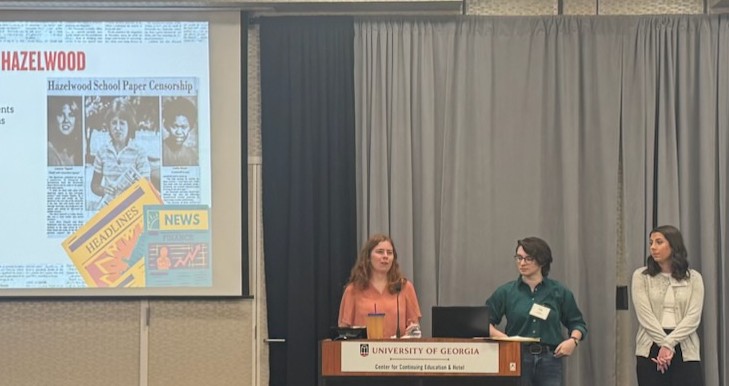
- Erin Keough (2L), Samantha Motley (3L), and Jordan Elwarner (2L) (pictured up top) presented on student press freedoms and best safety practices for journalists during the Georgia Scholastic Press Association‘s annual spring workshop.
- Keough, Motley, and legal fellow Christina Lee presented on media law basics and best safety practices to four UGA undergraduate journalism classes.
- Carly Judenberg (2L) and Nick Ames (2L) joined three high school journalism students in presenting on state-level protections for student press freedoms under “New Voices” laws in a webinar co-sponsored by the Student Press Law Center and the Georgia First Amendment Foundation.

PUBLICATIONS
- Julia Terry (2L) published “Filming the State: How the Government is Criminalizing the Right to Record” with Georgia Lawyers for the Rule of Law.
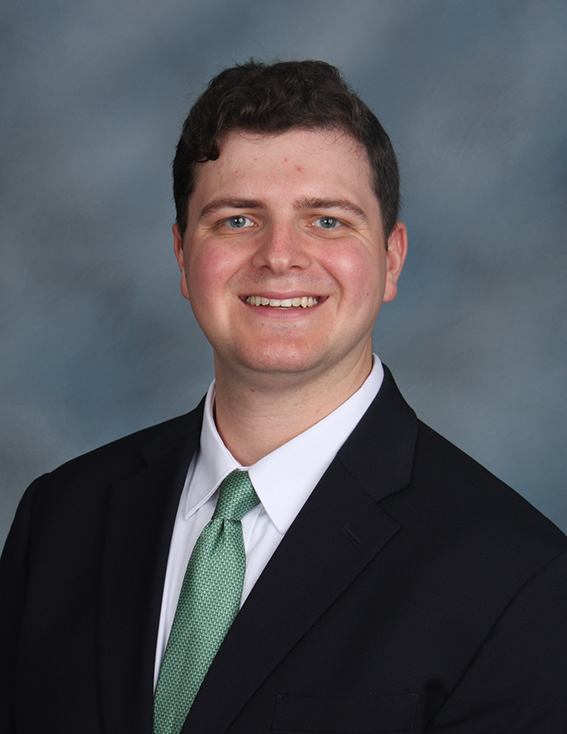
- Jacob Levy (2L) published “Georgia protesters could face severe penalties under new legislation” in the Georgia Recorder.

- Kellianne Elliott (3L) published “Under no-warrant DNA collection, any Georgian’s data could end up in police custody” in the Georgia Recorder.
- Elliott and Levy co-published “Georgia taxpayers paid for greater visibility into policing. Now lawmakers want to block their view” in the Georgia Recorder.
The Issue
Free Speech
The First Amendment protects the right of private individuals to engage in speech and expression without being censored or punished by the government because of their viewpoint. While the government may constitutionally regulate the time, place, and manner of private speech in public forums it must do so in a viewpoint-neutral manner and, depending on…
Explore Issue
The Issue
Media Law
The First Amendment guarantees a free press, meaning journalists are able to express any opinions they want about the government, even criticisms. However, journalists are often hindered in their ability to gather and publish news through the threat of lawsuits, subpoenas, and criminal prosecution. Read more about our support for student and professional journalists here.
Explore Issue
The Issue
Defamation Defense
Defamation is a false statement of fact that harms the reputation of a person, business, or organization. Journalists, news organizations, and even ordinary people can be sued for defamation, which is a common tactic to chill or silence legitimate speech and criticism. Read more about our defamation defense work here.
Explore Issue
The Issue
Right to Record
The First Amendment generally protects the right to gather information about what public officials do on public property, which includes the right to record matters of public interest. Although this right is clearly established, some government officials try to prevent or retaliate against those who record them. Read more about our advocacy for the right…
Explore Issue
The Issue
Speech-Based Retaliation
The First Amendment prohibits the government from retaliating against individuals exercising their rights to free speech, press, assembly, and petition of the government for redress of grievances. Read more about our work to address retaliation against individuals who have engaged in protected expression, newsgathering, and petitioning.
Explore Issue
The Issue
Student First Amendment Rights
The First Amendment protects students and student journalists from censorship and retaliation in public schools and universities. As the Supreme Court has explained, students do not “shed their constitutional right to freedom of speech at the schoolhouse gate.” Read more about our work on behalf of students and student journalists here.
Explore Issue